Wednesday, September 12, 2012

Class Questions, September 7-14

September 7
How might the following events be perceived as acts of aggression? as self-defense?
  • The Truman Doctrine
  • The Marshall Plan
  • The Soviet takeover in Poland
  • The unification of West Germany
  • The expansion of NATO into Eastern Europe
  • The Wars in Afghanistan and Iraq
  • An hypothetical intervention in Syria?

September 10
  • What is autarky?
  • Why did the typically isolationist US agree to provide the UK with Lend-Lease aid?
  • Why was the US so concerned with constructing a new world economic order?
  • Why would the US and UK want (West) Germany to regain its former strength?
  • Why was the US preoccupied with an integrated European economy?
  • Besides the potential threat from Moscow, what foreign threats motivated the US to construct the postwar security and economic orders?
  • Layne posits that the US would have pursued this policy even if the Soviet Union “didn’t exist.” Do you agree? Why or why not?

(more recent classes after the jump)

Sunday, September 9, 2012

Convergence

At the moment, you're reading about a period in history during which the world was split between two contrasting factions. Both powerful, one was capitalist and democratic, the other was communist and autocratic.

Today however, it seems like we're all moving the same direction, if at different paces. China opened up its economy and commenced a profitable march towards capitalism with Deng Xiaoping in the early 1980s. Russia did the same in 1991, albeit with far less success.

At a recent summit, both Chinese and Russian delegates extolled the virtues of low trade barriers, while Secretary Clinton called for stronger trade ties with Moscow.

What might be the international security implications of trade integration among these three, once very different, political economies? Why?

Thursday, September 6, 2012

Review for Wednesday, September 5

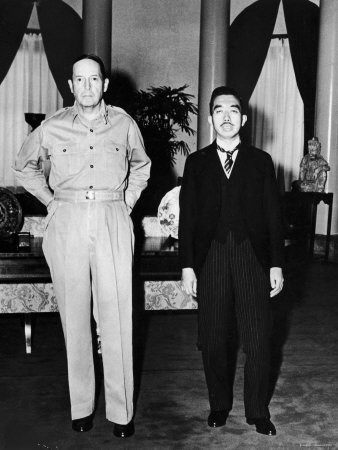
Gen. MacArthur &
Emperor Hirohito
Below is a list of questions that we discussed in class this past Wednesday:
  • In what way does having a global security interest indicate hegemonic aims?
  • Is a policy of preemption or prevention an indicator of hegemonic aims? How about a global network of naval and air bases?
  • Might there be defensive, non-expansionist reasons for seeing security interests all over the globe, for wanting to revise the international system?
  • Might there be non-hegemonic reasons for maintaining a global system of military bases?
  • If some policymakers in high ranking positions are calling for hegemony, does that make the state in question hegemonic?
Feel free to address these questions for participation points.

Tuesday, August 28, 2012

Review for Monday, August 27

(not so much that last thing)
There were no slides for Monday's class that I can post here, so I figured it might help to post the vocabulary words we went over and the questions we addressed.

Vocabulary
  • Polarity
  • Hegemon(y)
  • Offshore Balancing
  • Grand Strategy
  • Imperial Overstretch
  • Grand Strategy
  • "Open Door" Diplomacy
  • Parsimony
  • Security Dilemma
  • Structural Theory
  • Systemic vs. Domestic Variables

Questions
  • How can we tell the difference between a grand strategy of offshore balancing and one of hegemony?
  • Layne claims that a US focused on offshore balancing would retreat from Europe, East Asia and the Middle East and encourage a multipolar system. Is this accurate? Why would this be the case? Why might it not be?

If you have any questions or would like some clarification about the terms and questions presented above, feel free to ask about them in the comments. Bonus participation points to anyone who helps answer another student's question.

Monday, August 27, 2012

Expanding the North Atlantic Treaty Organization

NATO: Haqqani death "a blow" to Taliban, if true
A spokeswoman for NATO's International Security Assistance Force said in a statement to CBS News correspondent Kitty Logan Monday that the coalition wasn't in a position to confirm Haqqani's death but that, if true, it would be "significant." "Badruddin Haqanni is responsible for a number of high-profile suicide attacks in and around the Kabul area," the ISAF statement said.
NATO, originally a collective security alliance to deter Soviet aggression in Europe, has survived and expanded following the fall of the USSR. The current mission in Afghanistan is but one example: NATO forces have seen action in Kosovo and, more recently, Libya.

Does NATO's expansion and commitments to areas outside its original purview signal an expansion of American power? Or might there be some other motive behind the extension of the security community beyond the North Atlantic?

Tuesday, August 21, 2012

Syria, the US and Russia

Russia warns West over Syria after Obama threats
Russia warned the West on Tuesday against unilateral action on Syria, a day after U.S. President Barack Obama threatened "enormous consequences" if his Syrian counterpart used chemical or biological arms or even moved them in a menacing way... Russian Foreign Minister Sergei Lavrov, speaking after meeting China's top diplomat, said Moscow and Beijing were committed to "the need to strictly adhere to the norms of international law ... and not to allow their violation".
Read the article linked above and share your analysis of this situation in the comments. Why should Americans care about what goes on in Syria? Why would Russia and China be upset about the potential for American intervention?

Introductory Survey

Please remember to fill out the IS 190 introductory survey. The survey will help me get to know you better and tailor the class to your needs.

You can access the survey at http://www.surveymonkey.com/s/S7BJGFW. Completing the survey counts for your first day attendance and participation grade.